How Edge Computing Is Rewriting the Rules of Web Architecture
August 4, 2025
How Edge Computing Is Rewriting The Rules of Web Architecture

Something’s changed in the way we build for the web — and chances are, you’ve noticed it.
Maybe it’s that slow initial load when you’re in a different region.
Or the brief flicker before the interface finishes personalizing.
Or that API call that lags just a bit too long because it’s traveling halfway across the globe.
We’ve thrown everything at it — optimized servers, leaner frontends, global CDNs.
But even with all that, the experience still lags — especially when your users are worldwide, your logic is dynamic, and every millisecond matters.
So, what now?
We’re not just fine-tuning performance anymore.
We’re rethinking the system — shifting computation closer to where it makes the biggest difference: right next to the user.
That’s where edge computing comes in. Not as a buzzword, but as a real, tangible shift in how we architect the modern web.
What Edge Computing Actually Is

“When everything goes through the origin, lag is inevitable.”
Edge computing isn’t just about putting a few files on a CDN.
It’s about shifting meaningful logic — authentication, routing, personalization, even partial rendering — away from centralized servers and into lightweight execution environments distributed across the globe.
These environments, often called edge nodes, run closer to the end user. That physical proximity dramatically reduces latency and unlocks new user experiences that simply aren’t possible with the old centralized client-server model.
Instead of sending every request across the globe to a core backend, you now decide what must run at the origin — and what can be handled instantly, right at the edge.
Why Edge Computing Is Finally Practical
Edge computing has existed in theory for a while. But three key shifts have made it a practical strategy for modern development:
1. Frontend frameworks are edge-aware by default
Tools like Next.js, Remix, and Astro are no longer just about building UIs — they come with built-in support for edge-first logic. Developers can run middleware, server components, and routing logic at the edge without leaving their framework.
2. Global users are the norm
Whether you’re launching in one region or ten, users now expect consistent speed everywhere. You can’t afford to deliver great performance in one geography and sluggish load times in another.
3. Platform support has matured
You don’t need custom DevOps setups to deploy edge logic. Services like Vercel Edge Functions, Cloudflare Workers, and Netlify make it straightforward to deploy globally distributed code — without a new infrastructure team or a massive learning curve.
These aren’t just enablers — they’re signals. Edge-native thinking isn’t a niche anymore. It’s quietly becoming the new baseline.
What Teams Are Actually Doing at the Edge
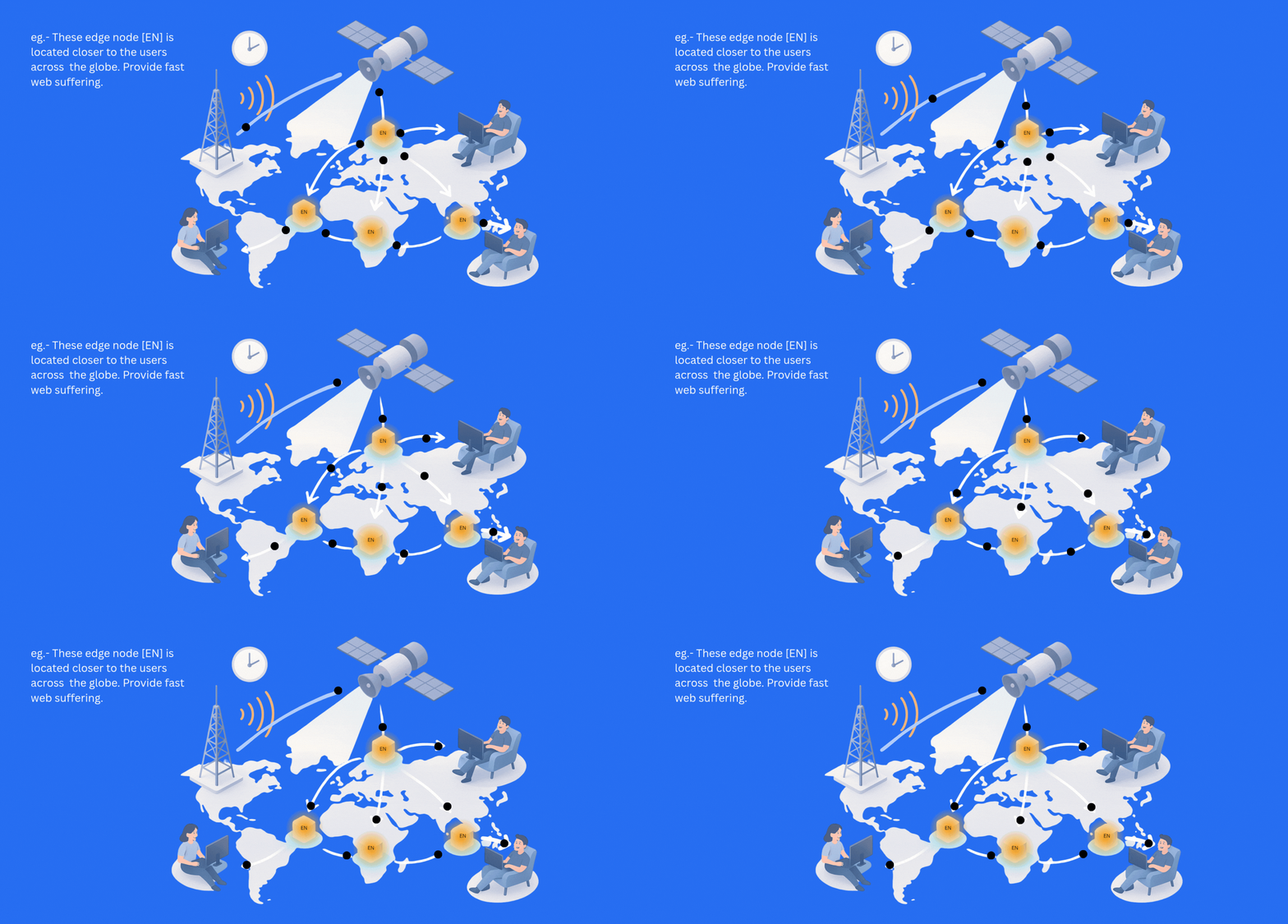
“Edge nodes bring logic closer to users — faster, smarter experiences.”
You don’t need to move your entire backend to the edge. That’s not the point.
Instead, teams are identifying the parts of their apps that can run faster and smarter when executed closer to the user. These are often lightweight but critical moments:
- Redirects based on location or language
- Instant personalization (without waiting on client-side JS)
- Pre-flight auth checks
- Smart routing or AB testing logic
- Partial rendering of content with fallback
These aren’t infrastructure-level optimizations. They directly impact how a product feels.
What’s powerful is that this doesn’t require a full rewrite. You can incrementally adopt edge logic — and immediately see the benefits in performance and perceived speed.
What Changes for Developers
The biggest shift isn’t just in infrastructure — it’s in how developers think.
Where we once had to choose between the client and the server, we now have a third execution environment: the edge. And that adds a new layer of architectural decision-making to everyday development.
Take a simple example:
Previously, determining a user’s location for routing or content personalization meant sending a request all the way to a centralized backend. Now, that logic can execute instantly at the edge — before the rest of the page even starts loading. It’s not just faster; it fundamentally changes where decisions get made and what “responsive” really means.
As a result, questions like “Should this logic run at the edge or the origin?” or “Can this be cached regionally?” are no longer backend-only considerations — they’re now showing up in frontend code reviews.
This mindset forces developers to account for failure isolation, geo-specific behavior, and graceful fallbacks — concerns that used to live deeper in the stack. And it stretches what we mean by “full stack” development. Today, it’s not just about moving vertically from database to frontend. It’s also about distributing logic horizontally — across the client, the edge, and the origin.
Final Thought
Edge computing isn’t just a performance hack — it’s a shift in how we architect for a distributed, real-time world.
As systems grow more global and user expectations sharper, the old client-server binary isn’t enough. The edge adds a new dimension — one that lets us move logic closer to where it matters most: the user.
Not every function belongs at the edge. But if your app isn’t considering it, it’s likely falling behind.
The real question isn’t “Should we use edge computing?”
It’s: “What would this look like at the edge?”